
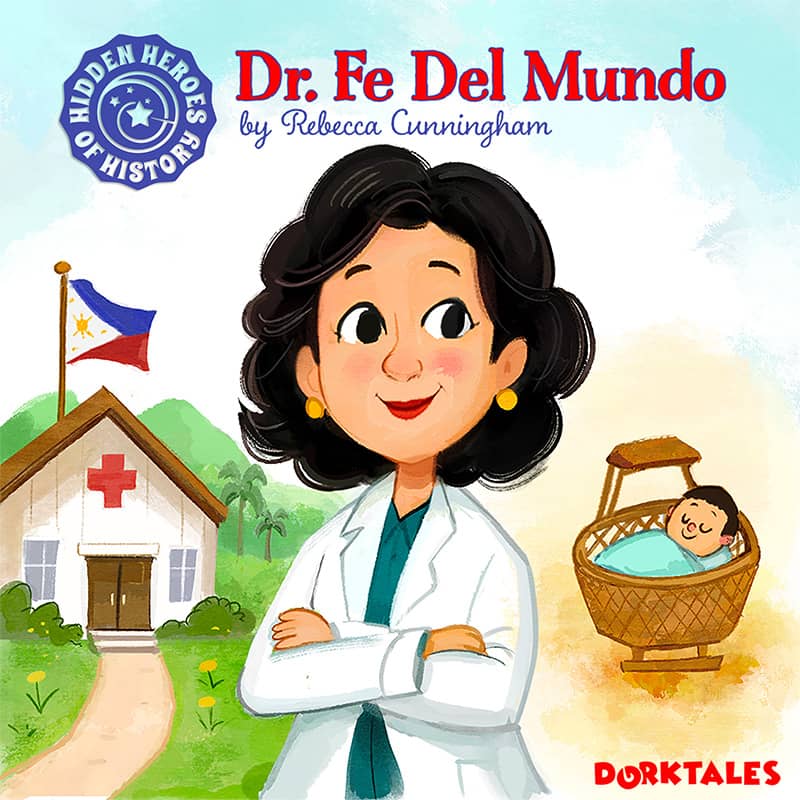






Dr. Fe Del Mundo
Filipina Pediatrician and Medical Inventor
Hidden Heroes of History
Dorktales Podcast: Episode 137
A tale of a trailblazing Filipina doctor and her life-saving invention! Inspired by her sister’s dream of becoming a doctor, Dr. Fe Del Mundo devoted her life to helping children. She broke barriers to study medicine and became the first Filipino and first person of Asian background to study at Harvard University. In the Philippines, she cared for children during World War II, opened the first pediatric hospital, and brought healthcare to children in rural communities. She also invented an incubator that didn’t need electricity, using bamboo baskets, hot water bottles, and other simple materials. Her remarkable work saved countless lives and earned her the title of National Scientist of the Philippines.
BONUS! Download the free Dr. Fe Del Mundo color page

FREE ACTIVITY GUIDE FOR THIS EPISODE!
We’ve created tools for parents and educators to keep kids’ imaginations engaged after listening to our podcast. Grab our FREE activity guide, worksheets and color page for this episode on Dr. Fe Del Mundo.
Podcast Episode Credits
Narration, Voice Over and Podcast Host: Jonathan Cormur
Scriptwriter: Rebecca Cunningham
Editing and Show Producer: Molly Murphy
Sound Production, Audio Editing and Mastering: Jermaine Hamilton
Podcast Episode Illustration: Arthur Lin
Title Design and Layout: Jeri DeMartini
Did You Know?
Dr. Fe Del Mundo was a remarkable doctor who was at the forefront of pediatrics, the branch of medicine that focuses on babies and children.
Dr. Fe Del Mundo’s name, when translated into English, means “faith of the world.” Through her work, she brought a lot of faith to the world and devoted her life to helping children.
Dr. Fe Del Mundo was born in the city of Intramuros in the Philippines on November 27, 1911. She was the sixth of eight children born to Bernardo and Paz Del Mundo. At the time, medicine was not as advanced as it is today. Dr. Fe experienced the loss of four of her siblings, including her older sister Elena.
Elena’s death had a big impact on Dr. Fe. One day, Dr. Fe found Elena’s diary and discovered that her sister had written about her dream of becoming a doctor. From that moment on, Dr. Fe decided to follow her sister’s dream and become a doctor herself.
At just fifteen years old, Dr. Fe enrolled at the University of Philippines College of Medicine in Manila. In 1933, she graduated as the class valedictorian, which meant she had the highest grades in her class. Her intelligence and hard work caught the attention of the President of the Philippines, Manuel Quezon. He offered her a scholarship to study in the United States.
America was quite different then, especially when it came to education. Many colleges did not admit women. In 1936, Dr. Fe was admitted to Harvard University, one of the top schools in the United States. She was also the first Filipino, and the first person of an Asian background to study there.
As a child, Dr. Fe had seen her brothers and sisters deal with illnesses. This helped inspire her interest in children’s health, especially malnutrition. Malnutrition happens when the body does not get the right amount of nutrition it needs to grow. It can happen when children do not have access to healthy foods.
Dr. Fe’s research in the United States did not stop with malnutrition.
She led studies on diseases that were serious problems for children in the Philippines at the time, including dengue fever, polio, and measles. Her work would later help establish the foundation for vaccine programs in the Philippines.
After graduating from Harvard, Dr. Fe decided to return home to the Philippines. She believed she could make the biggest difference there. But in 1941, World War II broke out.
During the war, internment camps were set up in the Philippines. People who were not born in the Philippines and were considered enemies were placed in these camps. One of the camps was at the University of Santo Tomas in Manila.
Dr. Fe decided to use her medical knowledge to care for the children who were sent there. She also volunteered with the International Red Cross. Dr. Fe was a selfless person who wanted to help others. Because of the care she gave to children at the camp, people began calling her the Angel of Santo Tomas.
After two years there, Dr. Fe moved to North General Hospital in Cebu City. She became the director and the first Filipina woman to lead a hospital. Doing something for the first time takes courage, and Dr. Fe continued to pave the way for others.
In 1957, Dr. Fe opened the very first pediatric hospital in the Philippines. It was a hospital created especially for children. Starting the hospital was a huge sacrifice. Dr. Fe sold everything she owned, including her house. She also took out a loan from the government and received donations from other people so she could open the hospital.
Dr. Fe knew the hospital was needed to save children’s lives. Children came there with illnesses like the ones her siblings had experienced, including abdominal and stomach problems. These problems were fairly common, but at that time they could sometimes become much more serious. Other doctors were not focusing on children’s health in the same way Dr. Fe was.
Dr. Fe also invented the BRAT diet. BRAT stands for Banana, Rice, Applesauce, and Toast. The diet helped hydrate the body, so a sick child who followed the BRAT diet could begin to feel healthy again.
But Dr. Fe’s work did not stop at her hospital. Her hospital was in a city, but she also wanted to bring medical care to children living in more rural areas. Rural towns and villages tended to have fewer people and less access to healthcare.
Dr. Fe was especially interested in babies who were born too early, known as premature babies. Premature babies have to fight harder to survive than babies who are born on time. In larger cities, premature babies could be placed in incubators. An incubator helped a baby grow and develop.
There was a problem, though. Rural areas did not have electricity, and incubators needed electricity to work. Dr. Fe found a way to solve this problem. She invented an incubator that did not require electricity.
Dr. Fe used materials that were available to her, including two bamboo baskets where the baby would be placed, a cloth that could be used as a scale to monitor the baby’s weight, hot water bottles to regulate the baby’s temperature, and a hood to provide oxygen.
The invention worked and saved countless lives.
In 1979, Dr. Fe became the first female to be named the National Scientist of the Philippines. Even then, she did not stop working. She continued helping others well into her 90s.
If you enjoyed this story about Dr. Fe Del Mundo, you may also enjoy learning about Dr. Kazue Togasaki, one of the first Japanese American women to become a doctor in the United States.