

Dorktales Podcast: Episode 61
Hidden Heroes of History
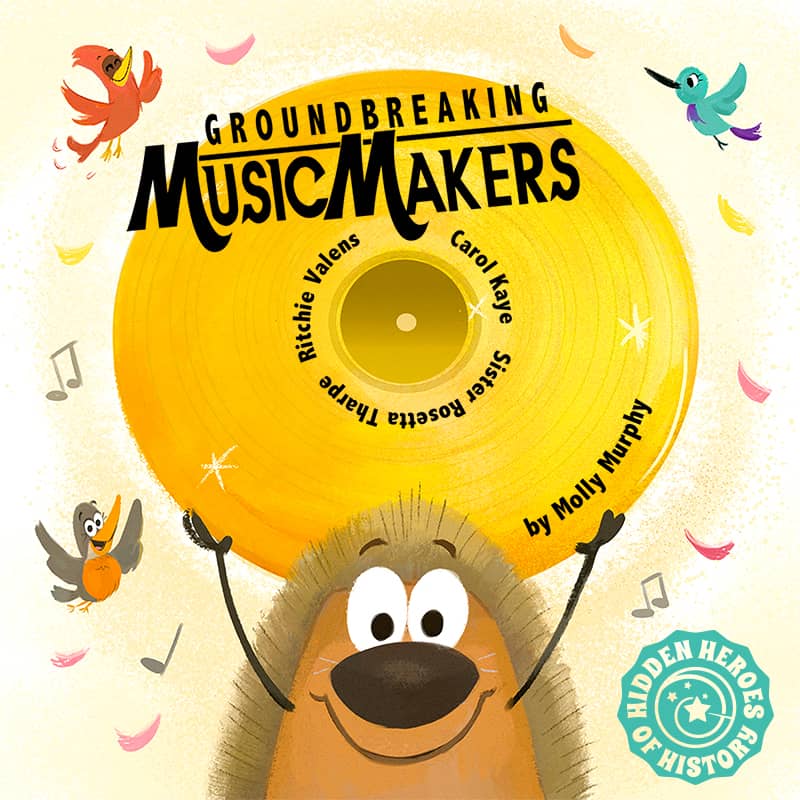
Groundbreaking Music Makers
Richie Valens, Carol Kaye and Sister Rosetta Tharpe
We’ve got stories of chart-topping trailblazers! Ritchie Valens broke cultural barriers with his musical style, and sparked the game-changing Chicano rock movement. Carol Kaye was the only woman on the famous ‘Wrecking Crew’. Always in high-demand, she laid down iconic bass tracks during 10,000 recording sessions. Sister Rosetta Tharpe crossed boundaries in sound and performance to become the Godmother of Rock and Roll, and creator of one of the very first recorded rock tracks. These three groundbreaking music makers played to the beat of their own drums and changed the tune of music history forever.

FREE ACTIVITY GUIDE FOR THIS EPISODE: We’ve created tools for parents and educators to keep kids’ imaginations engaged after listening to our podcast. Grab our FREE Dorktales+ portal for a Groundbreaking Music Makers Activity Guide, social-emotional guides, use-your-imagination activities, themed playlists and more!
Podcast Episode Credits
Narration, Voice Over and Podcast Host: Jonathan Cormur
Scriptwriter and Show Producer: Molly Murphy
Sound Production, Audio Editing and Mastering: Jermaine Hamilton
Podcast Episode Illustration: Arthur Lin
Title Design and Layout: Jeri DeMartini
Special thanks to Monique Hafen Adams who voiced Twiggy Branch and Kristin Schmitz who voiced Olive Branch in this episode.
Did You Know?
Ritchie Valens, Carol Kaye, and Sister Rosetta Tharpe were groundbreaking musicians who changed the course of music history. They composed the melodies and bass lines that modern musicians admire and fans still enjoy to this day.
Ritchie Valens
Ritchie Valens was a guitarist, singer, and songwriter, and a pioneer of the Chicano rock movement.
Chicano rock started when Mexican American youth were looking for new ways to express themselves and be seen. It is influenced by Mexican American culture.
When he was young, Ritchie Valens listened to traditional mariachi music and flamenco guitar as well as rhythm and blues. This sparked his interest in making music of his own, starting at age five.
Mr. Valens was encouraged by his father to take up guitar and trumpet. He was left-handed, but still mastered the traditional right-handed version of the guitar. He also taught himself the drums.
Starting in junior high, Mr. Valens would bring his guitar to school, singing and playing songs for his friends. When he was sixteen, he joined a local band called The Silhouettes. At first, he was the guitarist, and then took over the vocals when the lead singer left the band.
Bob Keane was the owner and president of a small record label called Del-Fi Records in Hollywood, California. He saw Mr. Valens play a Saturday-morning matinee at a movie theater. Afterwards, he offered Mr. Valens a chance to audition and from there, he signed Mr. Valens to his label. This meant that Mr. Valens would record his music exclusively for Mr. Keane, and the studio would support him by selling and promoting his music.
After Mr. Valens was signed, he co-wrote some incredibly popular songs. His most influential tune was “La Bamba.” It was the first hit sung entirely in Spanish, blending traditional Latin American music with rock. He was the first to successfully do this, and inspired generations of musicians after him to adopt the style.
Carol Kaye
Carol Kaye is a formative bass guitar player and session musician. The bass guitar holds down the beat in a song, and a session musician is someone who is hired to go into a music studio and record tracks for another musician. They could be hired to play guitar, bass, drums, vocals, and many other instruments.
Ms. Kaye’s parents were professional musicians. Her mom gave her a steel string guitar at age 13. The very next year, at 14 years old, she began teaching guitar professionally and playing sessions in jazz clubs around Los Angeles.
She was hired to play on Sam Cooke’s recording of the song “Summertime”, and realized she could make a better living as a session musician. Her career took off after a famous producer heard her play the acoustic rhythm guitar on Ritchie Valens’ track, “La Bamba.”
She transitioned to playing bass guitar when, in 1963, a bass player failed to show for a session. She was asked to fill in on the instrument and that’s how she learned that she preferred to play the bass. She said it allowed her to play more creatively.
During her time as a session musician, Ms. Kaye became the most in-demand bassist in Los Angeles. She is best known for her work as a member of the famous Wrecking Crew. The Wrecking Crew was a collective of session musicians who were hired for numerous studio recordings in the 1960s and 70s. While they weren’t well known outside of the music industry, they are now considered the most successful and influential session groups in music history.
Carol Kaye was the only woman in the Wrecking Crew. She was a trailblazer, creating a path for future generations of session musicians. She inspired several other bassists who were her contemporaries as well, including Paul McCartney from the Beatles.
Ms. Kaye recorded for many famous musicians, such as the Beach Boys, Frank Sinatra, Simon & Garfunkel, Stevie Wonder, The Supremes, The Temptations, and Barbra Streisand, to name a few.
According to the New York Times, she played in 10,000 recording sessions. And now, at age 87, she teaches and mentors others in the ways of the bass guitar.
Sister Rosetta Tharpe
Sister Rosetta Tharpe was a singer and guitarist. She was popular in the 1930s and 40s and is known as the Godmother of Rock and Roll.
Sister Rosetta Tharpe came from a family of religious singers. She picked up the guitar at four years old, and at the age of six, she performed with her mother in churches around the South.
She and her mother eventually settled in Chicago, where they continued performing spiritual music. As Ms. Tharpe grew up, she began fusing blues, New Orleans jazz, and gospel music into her playing. This would soon become her signature style.
Ms.Tharpe quickly became a music pioneer. She was the first recording star of gospel music, and her technique was revolutionary, as she was among the first recording artists to use heavy distortion on her electric guitar–an effect you can put on your guitar to make it sound gritty or fuzzy.
At the forefront of making rock and roll an international sensation, Ms. Tharpe wrote about both religious and non-religious themes—another groundbreaking moment for the artform.
Ms. Tharpe lived in a time of segregation, when people were separated due to their racial backgrounds. As a Black American, Ms. Tharpe experienced the effects of racial segregation. Despite crossing boundaries in music and performance, and becoming a popular artist, she couldn’t sleep in certain hotels on tour, or eat at restaurants across cities.
She had to overcome even more obstacles as a female guitarist in the very male dominated music industry. Still, at the young age of 23, she joined the Cotton Club Revue, a notable New York City venue, and recorded her first single. It was called “Rock Me’, and exemplified the true fusion of gospel and rock and roll.
After World War II ended, she produced a famous spiritual single called “Strange Things Happening Everyday” which was a reflection of the ‘strange things’ that were taking place in the world. It became her most well-known song, and the very first gospel song to make it onto the Rhythm and Blues (R&B) top 10 charts.
Many say “Strange Things Happening Everyday” was also one of the very first rock and roll recordings. Yet, when many people talk about the founders of rock and roll, they mention other names. She did not receive the recognition she deserved until recent years, and now more and more people are learning about her formative contributions to music history.
Artists like Little Richard, Johnny Cash, Elvis Presley, and Eric Clapton were inspired by Sister Rosetta Tharpe. She was finally inducted into the Rock and Roll Hall of Fame in 2018, and has received many other honors, including being pictured on a 32-cent commemorative stamp.

BECOME A DORKTALES SUPPORTER: Be the hero of our neurodiverse team’s storytelling journey and help us continue making great kids’ stories and content for families.