
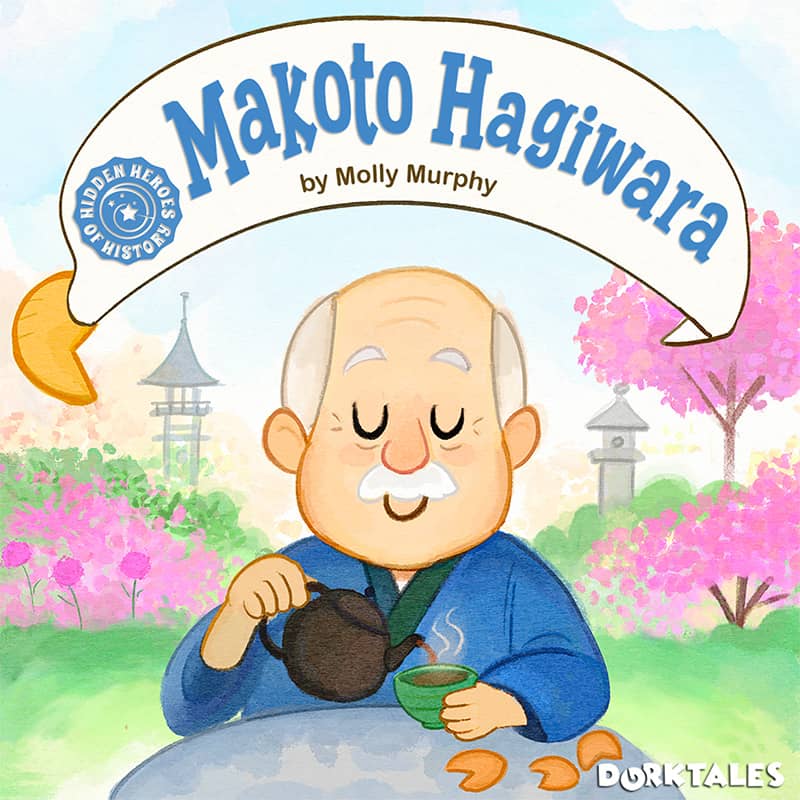

Makoto Hagiwara
Hidden Hero of History
Dorktales Podcast: Episode 121
A tale of artistry, innovation, and lasting legacy! Makoto Hagiwara, a Japanese American landscape architect, transformed a World’s Fair exhibit into the San Francisco’s Japanese Tea Garden. It’s the oldest public Japanese garden in the United States, still cherished as a place of peace and natural beauty. Makoto was also the inventive mind behind the modern fortune cookie! Despite wartime hardships and lost recognition, his creativity, friendship, and tasty experiments turned a simple crunchy cookie into a sweet symbol of good fortune enjoyed around the world.
FREE ACTIVITY GUIDE FOR THIS EPISODE!
We’ve created tools for parents and educators to keep kids’ imaginations engaged after listening to our podcast. Grab our FREE activity guides, social-emotional guides, use-your-imagination activities, themed playlists and more.
The Dorktales Storytime podcast episode on Makoto Hagiwara, Hidden Hero of History, was inspired by the Red Comet Press children’s book:
Fortune Cookies For Everyone!
The Surprising Story of the Tasty Treat We Love to Eat
By Mia Wenjen
Illustrations: Colleen Kong-Savage
Podcast Episode Credits
Narration, Voice Over and Podcast Host: Jonathan Cormur
Scriptwriter and Show Producer: Molly Murphy
Sound Production, Audio Editing and Mastering: Jermaine Hamilton
Podcast Episode Illustration: Arthur Lin
Title Design and Layout: Jeri DeMartini
Did You Know?
Makoto Hagiwara was a Japanese American landscape architect best known for his work on the Japanese Tea Garden in San Francisco’s Golden Gate Park. He is also credited with inventing the fortune cookie.
San Francisco, California. In the heart of the city lies a vast park spread out over more than a thousand acres called Golden Gate Park.
In 1894, the World’s Fair was held there, featuring a “Japanese Village” exhibition. That exhibit was transformed by landscape architect Makoto Hagiwara into the beautiful Japanese Tea Garden.
Makoto had an incredible vision for creating a peaceful Japanese garden with a tea house on five acres of land. He worked hard to expand and improve the garden, designing features such as the arched drum bridge, elegant pagodas, and plantings of native Japanese trees like cherry blossoms and maples. His dedication made the Japanese Tea Garden a tranquil, welcoming space for visitors to enjoy nature’s beauty.
The garden still stands today and is recognized as the oldest public Japanese garden in the United States. Makoto and his family even lived on the property in a twenty-four-room home, and his daughter, her husband, and their three children continued the legacy of caring for the garden.
Along with being a landscape architect, Makoto Hagiwara was also an inventor. He is credited as the creator of the modern fortune cookie. He served fortune cookies at the Japanese Tea Garden, making them by hand with an iron mold called a kata that bore his initials—M.H.
Makoto’s version of the fortune cookie is believed to have been inspired by a Japanese cracker called tsujiura senbei, popular in Kyoto during the 19th century. These crackers were sold at shrines and temples as souvenirs and always contained a small paper fortune inside. At first, Makoto flavored his cookies with miso, just like the original crackers from Japan, giving them a slightly savory taste.
The cookies quickly became popular, and Makoto turned to his friend and baker, Suyeichi Okamura, for help. Because it took so long to make each cookie by hand, Suyeichi suggested switching the flavor from miso to vanilla and sugar to appeal to white American tastes. This sweeter version became the fortune cookie we know today.
If you are enjoying this story, try this playlist of Asian American Hidden Heroes of History who were belonging builders and community creators like Makoto Hagiwara.
Suyeichi’s bakery made fortune cookies for Makoto, and they sold out every day. During that time, many Japanese Americans operated Chinese restaurants, since sushi wasn’t yet popular. They began serving fortune cookies at the end of every meal, and diners loved the surprise inside each one.
To meet the growing demand, Suyeichi designed a machine that could make many fortune cookies at once. It worked like a small crêpe maker with multiple arms. Workers would peel off the piping-hot cookies, slip a paper fortune inside while they were still soft, and fold them into their distinctive shape.
However, World War II brought many changes for Japanese American families like Makoto’s and Suyeichi’s. After the attack on Pearl Harbor in 1941, many Americans unfairly blamed all Japanese people, including Japanese Americans, for the tragedy. The U.S. government forced Japanese Americans to leave their homes and live in concentration camps. When this happened, Chinese American bakers took over the fortune cookie business.
After the war ended, life was difficult for Japanese American families. Makoto’s family was not allowed to return to their home at the tea garden, and over time, the story of who invented the fortune cookie was lost. The cookie’s popularity continued to spread across the country, and people no longer remembered its true origins.
In 1983, a mock trial was held because both Los Angeles and San Francisco claimed to be the birthplace of the fortune cookie. During the trial, someone from a Los Angeles bakery presented a kata (an iron mold) as proof. But it had Makoto Hagiwara’s initials, M.H., on it. The mold had disappeared from San Francisco decades earlier and ended up in Los Angeles. During the war, when Japanese Americans were only allowed to take what they could carry, many of their belongings were stolen or lost, including Suyeichi’s bakery equipment, the fortune cookie machine, and the kata.
Thanks to this discovery, Makoto Hagiwara’s story was finally restored. His contributions to the creation of the fortune cookie and his stewardship of the Japanese Tea Garden were recognized as important parts of both Japanese American and U.S. history.
In 1974, artist Ruth Asawa designed a bronze plaque featuring frogs as a tribute to the Hagiwara family. It stands near the front gate of the Japanese Tea Garden and reads:
“To honor Makoto Hagiwara and his family who nurtured and shared this garden from 1895–1942.”