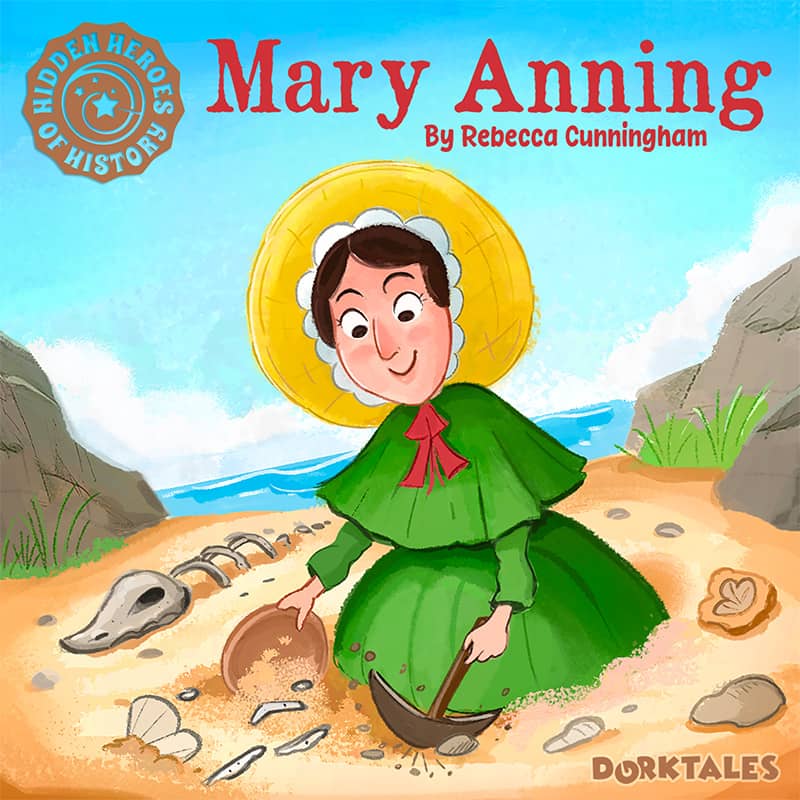

Mary Anning
Hidden Heroes of History
Dorktales Podcast: Episode 109
A story of early Earth science in action! Mary Anning was a pioneering paleontologist and fossil hunter who reshaped our understanding of prehistoric life. Growing up by the seaside cliffs of Lyme Regis, England, she uncovered ancient creatures hidden in the rocks—like giant sea reptiles and even fossilized dinosaur poop! Her discoveries helped scientists understand that creatures could go extinct and that the Earth was much older than people once believed. Her work was often dismissed and she rarely received the credit she deserved. Today, she is known around the world as the unsung hero for the scientific study of life through fossils.
FREE ACTIVITY GUIDE FOR THIS EPISODE!
We’ve created tools for parents and educators to keep kids’ imaginations engaged after listening to our episode on Mary Anning. Sign ups also gain access to more activity guides, social-emotional guides, use-your-imagination activities, and themed playlists.
Podcast Episode Credits
Narration, Voice Over and Podcast Host: Jonathan Cormur
Scriptwriter: Rebecca Cunningham
Editing and Show Producer: Molly Murphy
Sound Production, Audio Editing and Mastering: Jermaine Hamilton
Podcast Episode Illustration: Arthur Lin
Title Design and Layout: Jeri DeMartini
Did You Know?
Mary Anning, an English fossil collector, dealer and paleontologist, was an unsung hero of early fossil discovery.
She was born on May 21, 1799 in Lyme Regis, a town in west Dorset, England. It is by the English Channel and is known for fossil-filled cliffs that overlook a vast ocean.
Fossils are the remains of prehistoric plants or animals, typically older than 10,000 years, that have been buried and mineralized in rock. They can be anything from bones and shells to footprints or burrows. Fossils provide evidence of past life and help scientists understand Earth’s history. Lyme Regis, where Mary grew up, was a treasure trove of fossils just waiting for Mary to discover them!
Mary grew up to be an inquisitive and smart child. Mary didn’t go to school, like many children do today. During the time in which she lived, it was unusual for girls to attend school. Only girls from wealthier families had any chance to get an education. Mary learned to read and write because she attended Sunday school.
Mary’s dad was a cabinet maker, but he couldn’t fully support his family on that income alone. He realized that he could dig for fossils in the cliffs and sell them at a table in front of his house to tourists. He would break open a clay rock with a chisel and it would reveal fossils called ammonites. Back then, they didn’t have a scientific term for fossils. He called them ‘snake stones’ because the fossils looked like a coiled snake.
Every day, Mary’s dad would wake up early in the morning, dig for fossils, clean them up, and make little cabinets to display them in. He taught Mary and her brother Joseph how to do the same thing. He even gave Mary her own little pick-axe to dig for fossils. Both she and her brother learned to work hard and be scrappy.
When Mary was 8 years old, her dad had an accident and passed away. It was a very sad and hard time for the family. Both children became responsible for earning money. Joseph got a job and Mary started cleaning other people’s houses.
One day,a storm passed through Lyme Regis and, after it broke, Mary visited the cliffs to remember happy days with her father. When she arrived, she saw that the storm washed away the sand, rock and stone to reveal all sorts of fossils. She decided to go to the shore and collect some, just like she did when her dad was alive. That’s when she found a beautiful ammonite or snake stone.
When a well-dressed, fancy-looking woman saw Mary’s ammonite, she came right up to her and offered to buy it. It was enough money to feed Mary’s family for the week and pay the rent Mary quit cleaning then and there to restart her family’s business selling fossils from a table outside their cottage.
Joseph started to help Mary hunt and dig for fossils. There was one morning when he found a fossil in the shape of what looked like a crocodile skull. It was four feet long but didn’t have a body. Mary spent an entire year looking for it. Eventually she found the creature’s different body parts. When she put the fossils together, it was 17 feet long.
Someone purchased the crocodile-like curiosity for 23 pounds. That was enough to pay for six months of food and rent. The purchaser donated it to William Bullock’s Museum in Liverpool, England which displayed art, fossils and curiosities galore.
You could say that Mary’s fossil findings went viral. Thousands and thousands of people went to visit the museum, but Mary had no idea of its popularity. She just worked and worked, trying to find more fossils so she and her family could survive.
Meanwhile, people all over the world were arguing about what to call it. The word ‘dinosaur’ hadn’t been invented yet. Most people at the time thought the Earth had only existed for 4,000 years, but they were looking at something that could be 250 million years old. It really upset a lot of people that Mary’s discovery went against everything they believed in.
Finally, they decided to call it an ichthyosaur, also known as ‘Fish-Lizard.’ Before Mary, no one had ever seen a creature like this. But Mary rarely got credit for her discoveries.
Over the next few years, Mary met people who had more money and resources to help her. Henry de la Beche, who also lived in Lyme Regis, met Mary and Joseph when they were teenagers. Henry would go dig for fossils with them and grew up to become a world-renowned paleontologist.
Henry was admitted into the Geological Society of London, which didn’t admit women. And ultimately, he got to present a paper about Ichthyosauruses for which Mary was given no credit. There was little Mary could do about it, so she just kept working.
At 23 she found several fossils and, when put together, they looked like a giant strange-looking sea turtle. You couldn’t snap pictures of things at the time, so Mary learned to draw the fossils she found. She drew this creature and her drawing made its way to the Geological Society. Members thought she made the whole thing up because it looked so weird—a very long neck and a 5-inch head. Over time, people started to accept it was real, naming it a plesiosaur. The scientific paper written on the plesiosaur never mentioned Mary’s work.
Mary persisted in her efforts and continued to find other fossils, including pterosaurs, or ‘flying lizards.’ She also found tiny fossil rocks inside the pelvises of bigger creatures which turned out to be fossilized poop. This was a big deal because studying poop helps scientists learn more about what prehistoric creatures ate.
Mary’s name began to become known as her work showed up in museums. But Mary never even stepped foot in one and never saw her discoveries on display. By the time Mary was in her 40s, scientists finally started to accept the idea that creatures could go extinct and that they existed hundreds of millions of years ago. And a big reason they believed it was because of Mary’s findings.
The scientific community finally invented the word dinosaur—which means ‘terrible lizard’—to describe these extinct creatures. Dinosaurs changed the course of Mary Anning’s life and she changed the world. Today, she’s remembered as one of the most important fossil hunters of all time.
If you enjoyed this story about Mary Anning, you may also enjoy learning about Evelyn Cheesman, another Earth Science’s hidden hero of history who observed, collected and catalogued previously undiscovered insects, reptiles, amphibians, and plants—over 70,000 of them!