
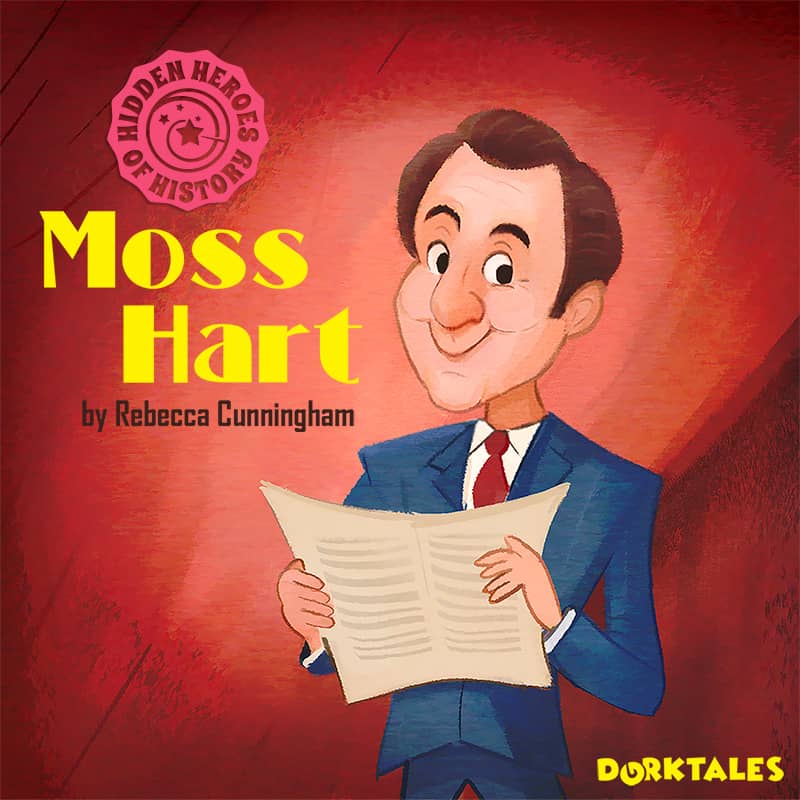

Dorktales Podcast: Episode 94
Hidden Heroes of History
Moss Hart
A captivating tale of determination and the bright lights of Broadway! From his beginnings in a Bronx tenement, Moss Hart became one of the most talented figures in American theater history. His journey from office boy to legendary playwright, stage director and screenwriter is a testament to the power of dreams and perseverance. His award-winning collaborations with George S. Kaufman and Irving Berlin left a lasting mark on the arts. And, his autobiography, “Act One” continues to inspire creative artists to this day.
FREE ACTIVITY GUIDE FOR THIS EPISODE!
We’ve created tools for parents and educators to keep kids’ imaginations engaged after listening to our podcast. Grab our FREE activity guides, social-emotional guides, use-your-imagination activities, themed playlists and more.
Podcast Episode Credits
Narration, Voice Over and Podcast Host: Jonathan Cormur
Scriptwriter: Rebecca Cunningham
Editing and Show Producer: Molly Murphy
Sound Production, Audio Editing and Mastering: Jermaine Hamilton
Podcast Episode Illustration: Arthur Lin
Title Design and Layout: Jeri DeMartini
Did You Know?
Moss Hart was an award-winning playwright, librettist (a person who writes scripts and music for musicals), and director for the Broadway stage and Hollywood films.
Moss Hart was born in 1904 and grew up in The Bronx in New York City where he lived in a tenement building. Tenements were low-rise buildings with multiple apartments, which were narrow and typically made up of three rooms. Immigrants in New York City often lived in tenement housing because rents were low.
Moss’s Aunt Kate loved going to live theater productions and she’d often take Moss with her to see a show. Going into downtown New York City, young Moss loved seeing Times Square and the lights of Broadway. His first time going there happened to be the day World War 1, a very big and terrible war that took place between many nations, had finally ended.
Moss witnessed people throwing confetti out of their windows, soldiers and sailors dancing on top of taxi cabs, and others hugging and dancing in the streets. It was a new day in the United States of America. There was so much joy all around and a new sense of hope everywhere. It sparked a sense of hope in Moss’s heart too. His dream was to open a show on Broadway one day.
The year after seeing Times Square for the first time, Moss had to drop out of school to take care of his parents and younger brother. His family never had much money. His dad was trained to make cigars but was suddenly out of work when a machine that rolled cigars was invented.
Moss started working at different jobs and by the time he turned 17, he finally found a job in the theater. He was an office boy for a theater producer named Augustus Pitou. An office boy was usually a young man who recently left school and was employed in an office to perform simple tasks, such as running errands and doing odd jobs.
It was while working for the producer that Hart, under a pseudonym, wrote a play produced by Pitou called, The Hold-Up Man or The Beloved Bandit. Moss’s boss read the script, loved it, and without knowing that the teenage Moss Hart wrote it, decided to put it on stage.
Unfortunately, The Beloved Bandit was a huge flop and Augustus Pitou lost $45,000. That would equal almost $800,00 today. Eventually he found out that Moss wrote the play and he was fired.
But just because he had one failure didn’t mean that Moss gave up on his dream to work in theater. He tried again and kept writing.
His next play, Once in a Lifetime, caught the interest of another theater producer who wanted to bring it to Broadway. He insisted that another playwright named George S. Kaufman work with Moss on the script. After six months of writing together, Once in a Lifetime had its Broadway premiere. It was a huge success!
This first Broadway production led to a 10-year theatrical partnership between Moss Hart and George S. Kaufman. They went on to write many shows together including Merrily We Roll Along, The Man Who Came to Dinner, and You Can’t Take It With You!
The team of Kaufman and Hart won the Pulitzer Prize for You Can’t Take It With You. The Pulitzer Prize is regarded as the highest national honor a writer can achieve. It is awarded each year for outstanding achievement to U.S. journalists, authors, playwrights and composers.
Moss continued his artistic pursuits throughout his life. He wrote with other celebrated creatives like Irving Berlin. He directed the very famous musicals My Fair Lady and Camelot. And then he’d move from the stage to the screen. He wrote screenplays for many movies including A Star is Born starring Judy Garland, the actress famous for another classic film, The Wizard of Oz.
Moss Hart took all the stories from his life—his childhood in the Bronx, his Aunt Kate, his first play with producer Augustus Pitou—and wrote an autobiography called Act One. An autobiography is a book a person writes about their own life. The book was a huge hit and to this day, it is one of the most widely read autobiographies by a person in the theater.
Moss Hart was one of the most talented figures in American theater history and one of the most successful authors of the 20th century. His life has inspired generations of playwrights, directors and actors to pursue their own creative careers.
If you enjoyed this story about a hidden hero who came from New York, you may also enjoy learning about Emma Lazarus, who played an important role in New York history.