

Dorktales Podcast: Episode 25
Hidden Heroes of History
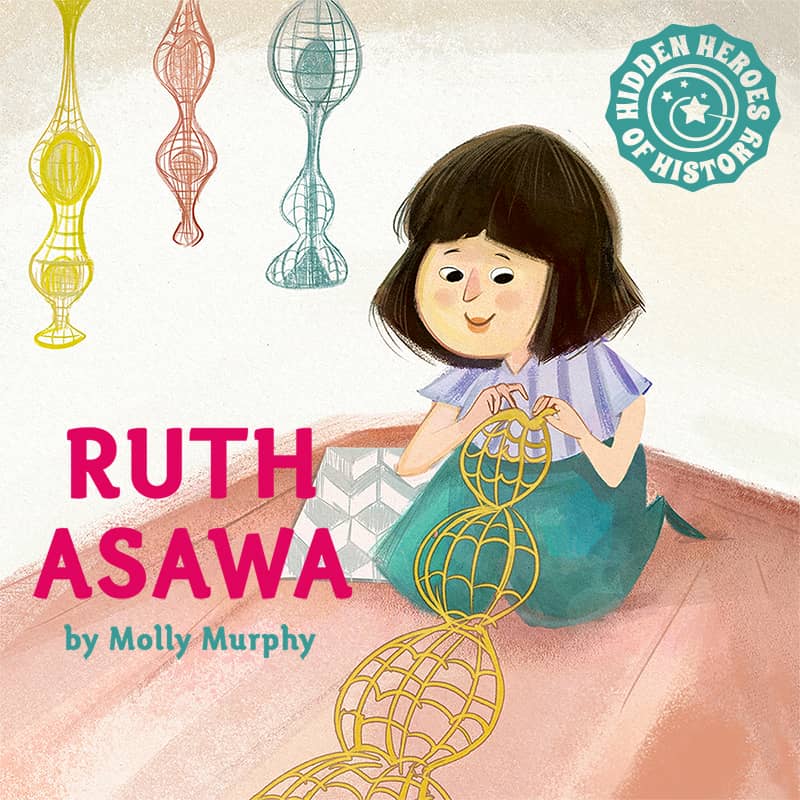
Ruth Asawa
A story of artistic triumph and long-lasting legacies! Ruth Asawa is one of California’s most beloved sculptors and was an influential advocate for arts education. She persisted through extreme prejudice and the injustice of Japanese internment camps to become a master at her craft. Today, her remarkable work lives on—from installations in famous museums, to monuments in city parks, to The Ruth Asawa San Francisco School of the Arts!

FREE ACTIVITY GUIDE FOR THIS EPISODE!
We’ve created tools for parents and educators to keep kids’ imaginations engaged after listening to our podcast. Grab our FREE activity guides, social-emotional guides, use-your-imagination activities, themed playlists and more.
Podcast Episode Credits
Narration, Voice Over and Podcast Host: Jonathan Cormur
Scriptwriter and Show Producer: Molly Murphy
Sound Production, Audio Editing and Mastering: Jermaine Hamilton
Podcast Episode Illustration: Arthur Lin
Title Design and Layout: Jeri DeMartini
Did You Know?
Ruth Asawa is one of California’s most beloved sculptors and was an influential advocate for arts education.
Sculptors make objects that have depth, can usually stand on their own, and sometimes, they even look like the subjects they are trying to portray. Sculptors can use a lot of different materials for their work—like clay, wax, stone, fabric, glass, wood, plaster, and random “found” objects.
Ms. Asawa created works in many different mediums, but one of her most popular materials was wire – her wire sculptures were like three-dimensional drawings, changing with the viewer’s perspective.
She was born in 1926 in California, after her parents immigrated to the United States from Japan. Immigration is when individuals move from the country in which they were born to establish lives in a new country.
Ms. Asawa had a passion for art from early on. As a child, she was encouraged by her third-grade teacher to create her own artwork. She even received first prize in a school arts competition in 1939 for her piece on what makes someone American.
World War II and Japanese Internment Camps
During World War II, the United States government forced over 100,000 Japanese Americans to live in internment camps. Internment camps were places where individuals’ rights were restricted, families were separated, and no one was allowed to leave and return home.
These actions were brought about by an event that took place on December 7, 1941: when the government of Japan declared war on the United States by attacking Pearl Harbor in Hawaii. Americans and the American government unfairly and unjustly blamed all Japanese and Japanese American individuals for the attack, contributing to rampant prejudice against innocent individuals.
Lies were spread on radio programs, and people were refused service at various businesses. There were even false rumors that Japanese Americans knew about Pearl Harbor ahead of time, and that they might be involved in planning future attacks.
This prejudice is what led to the unjust internment of thousands of people, including Ruth Asawa and her family who were put into an internment camp in 1942. Most of her family stayed together, however, Ms. Asawa did not see her father for almost two years.
She spent eighteen months in the internment camps, where she attended and graduated from high school. She also continued to learn about drawing and painting from other artists who were living alongside her—including animators from Walt Disney Studios.
An organization called the Japanese American Student Relocation Council gave Ms. Asawa a scholarship to attend college. In 1943, she was issued an identification card by the War Relocation Authority that permitted her to leave the internment camp and travel to Milwaukee. There, she attended Milwaukee State Teachers College, but because of the ongoing war and prejudice against Japanese Americans, she was prevented from getting her degree.
Black Mountain College Interdisciplinary Study
Ms. Asawa did find another school in North Carolina called Black Mountain College, where she began a deeper exploration of art making. She took courses across a variety of different forms, studying drawing, photography, composing, choreography, and sculpture with very prominent artists.
Her time at the college and her interdisciplinary study were extremely formative and also freeing. Interdisciplinary study means that a student combines their love for many areas of study into one educational path. For example, Ms. Asawa took a trip to Mexico during this time where she learned about basket weaving techniques. This informed some of her most iconic wire sculptures.
Museum Collections and Public Works
Throughout her adult life, Ms. Asawa created a large body of work. Today, her art resides in very famous museums like the Guggenheim and the Whitney Museum of American Art in New York. Some of her wire sculptures are on permanent display in San Francisco’s de Young Museum in Golden Gate Park.
Later in her career, Ms. Asawa was commissioned to make many public works, including multiple fountains. She also designed a Japanese American Internment memorial in San Jose, California. Public Art is so important, because it brings culture to cities and helps us to never forget our past.
Two of her most famous fountains are in San Francisco. The first is called Andrea’s Fountain and is located in the ever-so-popular Ghirardelli Square. The second is near Union Square where she created a fountain with the help of 200 school children. She had them mold hundreds of images of the city of San Francisco using baker’s clay, which is a cheap, easy-to-make, and extra safe material. The children’s shapes were then cast in iron to make the fountain.
Arts Education Advocacy
Ms. Asawa turned her early interest in teaching into becoming a dedicated advocate for arts education. She believed teaching the arts in school was a vital part of empowering young people, and felt hands-on learning was an invaluable experience. She championed these principles throughout her entire career.
Her first major project was building a program called the Alvarado School Arts Workshop. It began with no money and only household materials for art-making—like milk cartons, egg cartons, and scraps of yarn. The program eventually grew to be in over 50 public schools in San Francisco, and included teaching musicians, gardeners, parents, and all sorts of professional visual artists.
Throughout her life, Ms. Asawa spoke to politicians and organizations about supporting arts programs in San Francisco. As part of this work, she contributed to the creation of a public arts high school that was eventually named the Ruth Asawa San Francisco School of the Arts in her honor.
Visit the Ruth Asawa Website to view her art and learn more about this amazing hero of history!
Books About Ruth Asawa
A Life Made by Hand: The Story of Ruth Asawa
Written by Andrea D’Aquino
“For ages 5-8, introduction to Japanese-American artist and sculptor, includes activity for making a paper and a page of teaching tools for parents and educators.”
Women in Art: 50 Fearless Creatives Who Inspired the World
Written and Illustrated by Rachel Ignotofsky“Women in Art celebrates the success of the bold female creators who inspired the world and paved the way for the next generation of artists.” (Includes Ruth Asawa)
Books About Japanese Internment Camps
Write to Me: Letters from Japanese American Children to the Librarian They Left Behind
Written by Cynthia Grady
Illustrated by Amiko Hirao
“A touching story about Japanese American children who corresponded with their beloved librarian while they were imprisoned in World War II internment camps.”
Fish for Jimmy
Written and Illustrated by Katie Yamasaki
“This affecting tale of courage and love is an adaptation of the author’s true family story, and includes a letter to readers with more information about the historical background and inspiration.”
They Called Us Enemy (Graphic Novel)
Written by George Takei, Justin Eisinger and Steven Scott
Illustrated by Harmony Becker
“A stunning graphic memoir recounting actor/author/activist George Takei’s childhood imprisoned within American concentration camps during World War II. Experience the forces that shaped an American icon—and America itself—in this gripping tale of courage, country, loyalty, and love.”