
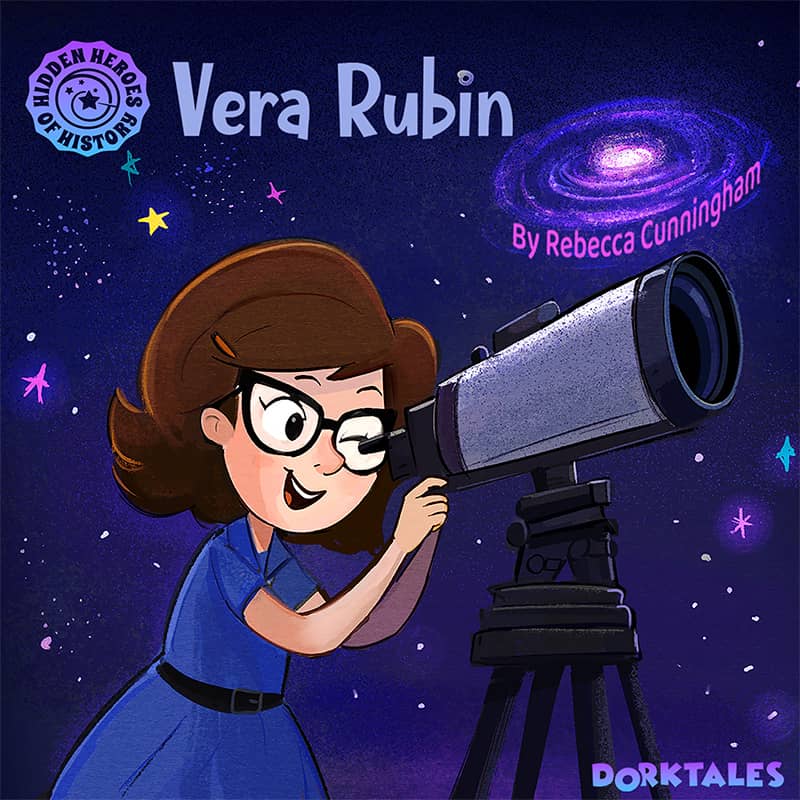

Dr. Vera Rubin
Hidden Heroes of History
Dorktales Podcast: Episode 133
A story of galactic grit and refusing to give up! Dr. Vera Rubin’s love of science and the stars began early. At 14, she and her father built a cardboard telescope so she could track meteors. She dreamt of becoming an astronomer, a career many believed was impossible for a woman at the time. But Vera never let limitations hold her back. From her school days to her work as a scientist, she followed her curiosity, overcame obstacles, and made discoveries that changed astronomy forever. Explore the inspiring life of the astronomer whose groundbreaking work helped reveal one of the universe’s greatest mysteries: dark matter.
BONUS! Download the free Vera Rubin color page to imagine what’s out in space!

FREE ACTIVITY GUIDE FOR THIS EPISODE!
We’ve created tools for parents and educators to keep kids’ imaginations engaged after listening to our podcast. Grab our FREE activity guide for this episode on Dr. Vera Rubin.
Podcast Episode Credits
Narration, Voice Over and Podcast Host: Jonathan Cormur
Scriptwriter: Rebecca Cunningham
Editing and Show Producer: Molly Murphy
Sound Production, Audio Editing and Mastering: Jermaine Hamilton
Podcast Episode Illustration: Arthur Lin
Title Design and Layout: Jeri DeMartini
Dorktales Fan Page
Come to the Dorktales Fan page, the place where the magic of Dorktales Storytime continues beyond the podcast. Discover activities, coloring pages, fan challenges, and other fun extras inspired by your favorite Dorktales adventures. Plus, there are lots of ways to share your artwork, questions, and story ideas with Jonathan and Redge.
Did You Know?
Dr. Vera Rubin was an astronomer whose groundbreaking work studying how galaxies moved changed astronomy as we know it forever.
Vera Rubin was born as Vera Cooper on July 23, 1928, in Philadelphia, Pennsylvania. Her parents were Jewish immigrants from Eastern Europe who always encouraged and supported Vera’s love of science and space. When she was 14, her father even helped her build a telescope out of cardboard, which she used to track meteors.
When Vera got older, she enrolled at Vassar College, where her idol Maria Mitchell taught. Vera graduated in 1948 and was the only astronomy major in the entire school. At the time, there were limited expectations for young women, and becoming an astronomer was considered out of the question.
But Vera did not let limitations get in her way.
She applied to Princeton University to study astronomy, but Princeton would not enroll women. Instead, she attended Cornell University, where she studied 109 different galaxies.
While at Cornell, Vera presented her research despite being discouraged by a professor who doubted her ideas. When she was invited to share her work at a major astronomy conference, the professor suggested he present it under his own name because Vera had just had a baby. Vera refused to let that stop her. She drove through a snowstorm with her one-month-old baby to attend the meeting herself.
Although she felt imposter syndrome and received negative feedback, Vera continued pursuing her dream. She earned a PhD in astronomy from Georgetown University and became Dr. Vera Rubin.
While earning her PhD, Vera studied how galaxies were arranged throughout the universe and discovered that they tended to clump together instead of being spread evenly.
After earning her doctorate, Vera became a professor and later joined the Carnegie Institute as an astronomer. In 1965, she became the first woman admitted to the Palomar Observatory. When she arrived, she discovered there were no women’s restrooms. Instead of giving up, she creatively adapted the sign to the men’s restroom so she could have access as well and continue her work.
Vera Rubin believed that there was no problem a man could solve that a woman could not solve as well.
Vera worked with astronomer Kent Ford to study how spiral galaxies rotate. Scientists expected objects near the center of a galaxy to move much faster than objects farther away. But Vera discovered something surprising: objects throughout a galaxy moved at nearly the same speed.
Many scientists doubted her findings, but Vera spent ten years gathering evidence. She studied more than 60 spiral galaxies and consistently found the same results. Her research provided some of the strongest evidence for the existence of dark matter, the mysterious invisible material that may help hold galaxies together.
By 1980, Vera had gathered so much evidence that other scientists could no longer ignore her discoveries. Her work transformed astronomy and changed how scientists understand the universe.

If you enjoyed this story about Dr. Vera Rubin, you may also enjoy learning about Dr. Ellen Ochoa, the first Latina female astronaut to go to space.