
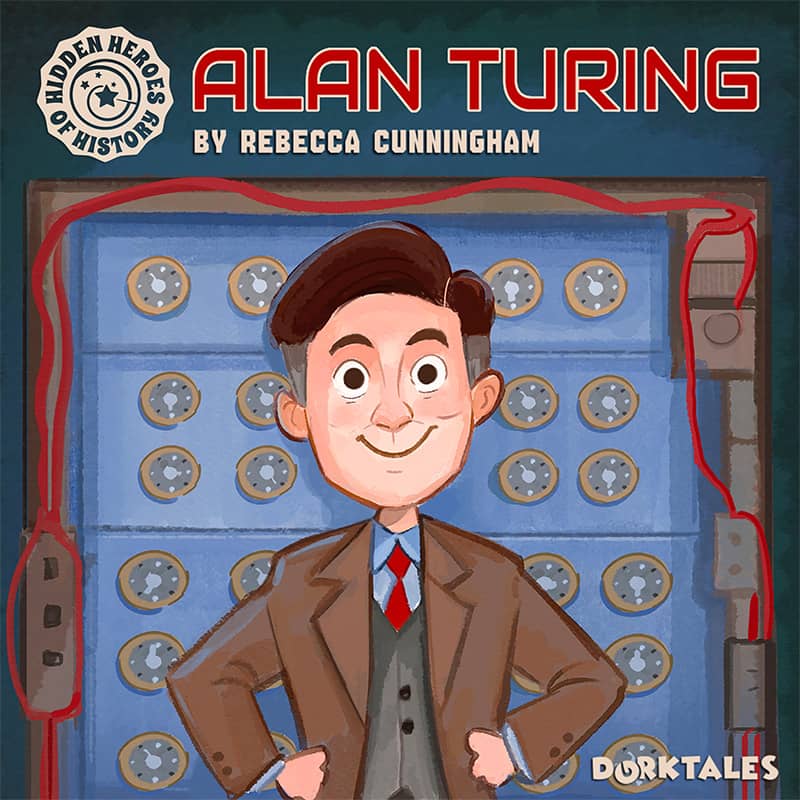

Alan Turing
Hidden Heroes of History
Dorktales Podcast: Episode 112
A tale of secret codes and early computers! Alan Turing was a British mathematician and thinker who helped turn the tide of World War II for the United Kingdom and its allies. His groundbreaking work also laid the foundation for much of the technology we use today. As a child, Alan loved solving puzzles—like tracking the patterns of bees—and as a teen, he spent many late nights working through challenging math problems. From imagining the Turing Machine to cracking the uncrackable Enigma Code, Alan’s story is one of brilliance, perseverance, and bravery. He didn’t always fit in, but his unique way of thinking changed the world.
FREE ACTIVITY GUIDE FOR THIS EPISODE!
We’ve created tools for parents and educators to keep kids’ imaginations engaged after listening to our podcast. Grab our FREE activity guide for Alan Turing, and you’ll also receive access to our resource library.
Podcast Episode Credits
Narration, Voice Over and Podcast Host: Jonathan Cormur
Scriptwriter: Rebecca Cunningham
Editing and Show Producer: Molly Murphy
Sound Production, Audio Editing and Mastering: Jermaine Hamilton
Podcast Episode Illustration: Arthur Lin
Title Design and Layout: Jeri DeMartini
Did You Know?
Alan Turing was a British mathematician and thinker who had ideas that set the stage for computers and artificial intelligence. During World War II, he played an important role in breaking secret Nazi codes.
Alan Turing was born in London, England to Julius and Ethel Turing on June 23, 1912. He was very smart and observant from a young age. While on a family holiday in Scotland, 7-year-old Alan used math to study the flight paths of the honey bees to locate their beehive. He discovered their honey, which he didn’t like. But what he did like was learning about the world around him.
He wasn’t like most boys he knew, which made it hard for him to make friends. He loved math, science, and books over physical and imaginative play. He had a high-pitched voice and didn’t always pick up on things like sarcasm. Sarcasm is when someone says the opposite of what they mean, usually to be funny or to make a point. Many experts today think Alan Turing may have been on the autism spectrum.
At 13, Alan began his studies at a boarding school 60 miles away from his home in Southampton, England. A boarding school is where students both study and live. There was a train strike on the day Alan was supposed to leave for his new school. He found out at the last minute, so he rode his bicycle the whole way there—and he arrived on time!
Alan spent the rest of his life using his bicycle as his main source of transportation. He was very athletic. In fact, he almost made it as a member of the British team for the 1948 London Olympics, but an injury prevented him from competing.
As an adult, Alan rode his bicycle to work every day—it was a very old bike with a chain that fell off while he was riding. He’d stop to fix it and get his hands dirty with grease. But instead of getting a new bike, Alan enjoyed trying to figure out why it kept breaking. That was just the way his brain worked. He loved puzzles.
His best friend at boarding school was Christopher Morcum. Christopher loved math and science almost as much as Alan, and they’d spend time working on difficult math equations together. Christopher was the first person who Alan thought truly understood him. Sadly, Christopher died from a disease called tuberculosis at age 18.
His friend’s death was very sad for Alan, but he was determined to honor his memory. Alan kept studying and doing his work in math and science.
After graduating, Alan attended the University of Cambridge in England, one of the best universities in the world. From there, he continued his studies at Princeton University, another top-notch school in the United States. This is where he earned his PhD, or doctorate, which is the highest degree you can earn in school.
While at Princeton, Alan came up with an idea he called “The Turing Machine.” It’s a machine that’s able to decode and perform any instructions you give it. This breakthrough idea is what led to the creation of the computers that people use all over the world today.
If you enjoyed this story about Alan Turing, you may also enjoy learning about Mary Golda Ross, another STEM hero of history whose early work in space exploration helped put humans into space.